Author
Dr.Sc Ed Connor

Published
5th October 2026

PFAS analysis of Intura H2, N2 & ZA gas output

Ed Connor Dr. Sc., Product Manager


Per- and polyfluoroalkyl substances (PFAS) are persistent contaminants that can compromise trace analysis if introduced through laboratory equipment or gas supplies.

This study evaluated whether PEAK Scientific Intura H2, N2 and Zero Air generators contribute volatile or semi-volatile PFAS to their output gases. Direct collection of generator output gas onto pre-conditioned PFAS thermal desorption tubes and analysis via GC-MS showed that Intura H2 produced a very low analytical background, with no fluorinated peaks detected and that samples from Intura N2 and Zero Air, despite showing greater volatile organic compound background, were also absent of any PFAS signature ions. These results demonstrate that the Intura generators do not introduce detectable PFAS or fluorinated compounds into their gas streams and are unlikely to interfere with PFAS determination by GC or GC–MS.

Introduction

Per- and polyfluoroalkyl substances (PFAS) are a diverse class of highly persistent synthetic chemicals that have been manufactured and used in industrial and consumer applications since the 1950s1. Their widespread adoption is largely due to their exceptional thermal stability and chemical inertness, however, these same properties also make PFAS environmentally persistent and recent studies highlight risk of their bioaccumulation and as potential carcinogens2.

With over 6000 compounds now recognised3 and substantial quantities of PFAS introduced to global markets each year, analytical laboratories supporting increasing global regulation are under pressure to eliminate potential sources of contamination that could impact analytical results from materials, consumables and equipment used within laboratory workflows.

This application note assesses the PFAS content of PEAK Scientific’s Intura H2, N2 and Zero air gas generator range using thermal desorption coupled to GC-MS analysis. The majority of PFAS analysis utilises LC-MS4, however, volatile and semi-volatile PFAS species, including fluorotelomer alcohols (FTOHs), can be effectively analysed by TD GC-MS. TD offers a complementary route for PFAS screening because it enables direct analysis of sorbent-tube samples without solvent dilution, supports large-volume air sampling and can provide the sensitivity and selectivity required for low-level target detection5.

Experimental

Gas Sampling: To determine whether the Intura gas generators could impact on PFAS analysis, samples of output gas were collected directly from Intura H2 and Intura N2|ZA gas generators onto pre-conditioned PFAS TDS tubes (U-T24PFAS-2S, Markes International Ltd, Bridgend, UK). A total volume of 300L was collected from each generator, with the output flow rate restricted to 250 sccm using a Mass flow controller (EL Flow, Bronckhurst, Ruurlo, Netherlands). Control samples were collected using a dry scroll pump (nXDS6i, Edwards, Burgess Hill, UK) connected to TDS tubes to sample laboratory air. One additional control sample was an unused U-T24PFAS-2S that was analysed to ensure no influence of tube storage on results.
Sampling Conditions
Gas generator Intura H2 Intura N2|ZA
Gas Hydrogen Nitrogen & Zero Air
Flow rate 250sccm 250sccm
Total volume 300L 300L
TDS tube U-T24PFAS-2S U-T24PFAS-2S
Mass flow controller EL-Flow EL-Flow


TD Method
Model TD100-xr
Flow path temperature 180ËšC
Dry purge : Purge flow 1 min, 50mL/min
Desorption temperature & time 260ËšC for 10 min
Trap in Line (flow) 50mL/min
Trap Purge 1 min at 50 mL/min, 25°C
Trap low temperature 25°C
Trap desorption time 260°C for 4 min
Outlet split 6 mL/min


GC Parameters
Model Agilent 8890 GC
Column DB-624 30 m x 0.25 mm x 1.4 μm
Carrier Gas Helium
Column Flow 1.5 mL/min
Oven programme 40°C (2 mins), 10°C/min to 230°C (5 mins)


MS Parameters
Model Agilent 5977B GC-MSD
Source Type Extractor
Quadrupole temperature 150°C
Source temperature 230°C
Acquisition mode Full scan
Scan range m/z 35-350
Ionisation mode EI, 70 eV

Results & Discussion

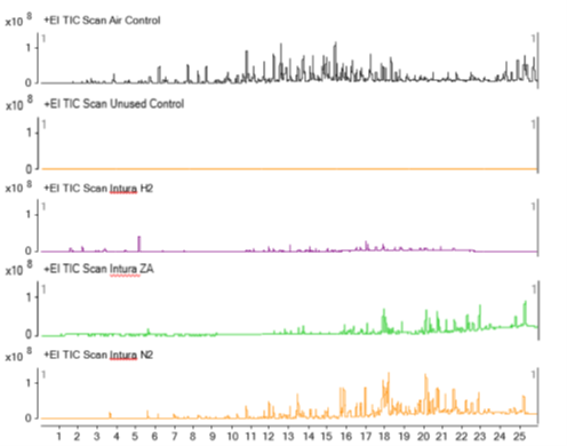
Intura H2: The output of hydrogen gas from Intura H2 was found to contain very low background (Fig. 1C), with no fluorinated peaks detected (Fig. 2A-C). Since Intura H2 produces gas from de-ionised water dissociated to H2 and O2 via the proton exchange membrane (PEM) cell, within a closed system, the absence of any fluorinated materials within the gas delivery componentry ensures that Intura H2 will not contribute PFAS to GC or GC-MS background signal. The results demonstrate that there is little risk of any environmental PFAS dissolving into the generator’s external water supply and migrating through the PEM cell and into the gas stream.


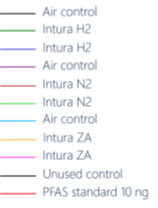
Figure 1. TIC of air control, unused control, Intura H2, Intura N2 and Intura ZA from GC-MS analysis of PFAS TDS tubes.


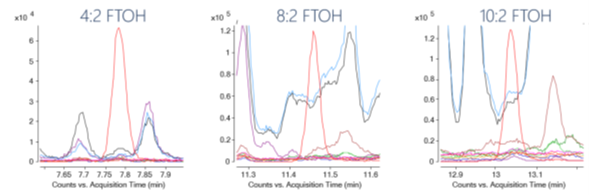
Intura N2 & ZA: Since Nitrogen and Zero Air are generated from ambient air, there is a significantly greater opportunity for environmental PFAS to enter the generator and impact gas quality, which could result in interference in PFAS analysis. Results from Intura N2 and Intura ZA show significantly higher VOC background compared with Intura H2, owing to concentration of environmental VOCs on TDS sample tubes during collection, however, samples spiked with FTOH standard showed an absence of m/z 95 signature ion that would indicate presence of PFAS (Fig. 2).


Figure 2. 10ng 4:2 FTOH, 8:2 FTOH and 10:2 FTOH m/z 95 peaks overlaid with generator and air control samples.


Results show no presence of Fluorotelomer alcohols (FTOH), which are a precursor of PFAS compounds, in any sample, with only air control samples exhibiting higher ion background abundance at similar retention time to FTOH standards. The absence of m/z 95 signature ions from any of the generator gas analysis indicates that Intura N2 and Intura ZA do not directly contribute any fluorinated compounds in their output gas, demonstrating that Intura N2 & ZA generators will not impact PFAS analysis by GC / GC-MS.

Conclusion

Results from this study demonstrate that gas output from the Intura H2, N2 and ZA generators does not contain PFAS and that gas supplied from these generators is unlikely to result in interference with GC or GC-MS analysis. Intura H2 produces UHP hydrogen from de-ionised water in a closed system and results show that the high-quality materials used in the generator’s construction contribute no PFAS to the gas output. Results also show that the Intura N2 and ZA generators contribute no PFAS from any internal componentry within the generator.

Acknowledgements

PEAK Scientific would like to thank Markes International for providing pre-conditioned PFAS tubes for sample collection and for carrying out subsequent GC-MS analysis.

References

1 Fluorinated Surfactants and Repellents (2nd ed.), Marcel Dekker, Inc, New York , NY (2001)

2 Kwiatkowski et al. (2020) Scientific Basis for Managing PFAS as a Chemical Class, Environmental Science & Technology Letters 7 (8): 532–543

3 Stockholm Convention on Persistent Organic Pollutants: Stockholm Convention - Homepage

4 Rehman et al. (2023) Current and emerging analytical techniques for the determination of PFAS in environmental samples. Trends in Environmental Analytical Chemistry, 37: e00198

5 Miles et al. (2022) Analysis of Trace Perfluorinated and Polyfluorinated Organic Vapors in Air. Using cryogen-free thermal desorption and GC/MS. Agilent Technologies Application Note.


About the author

Dr Ed Connor

Ed Connor Dr. Sc. is a Product Manager at PEAK Scientific with a background in GC & GC-MS analysis. Having completed his PhD at ETH Zurich on herbivore-induced plant volatiles, Ed then moved to the University of Zurich where his work focused primarily on volatile collection methods and analyses using GC-MS and GC-FID.

Subscribe to our newsletter for regular product updates, news and insights.